Color & finish
How to test paint colors before you commit
A paint chip can look perfect in the store and wrong on your wall. Testing the right way helps you catch undertones, light changes, and finish issues before you spend money on gallons of paint.
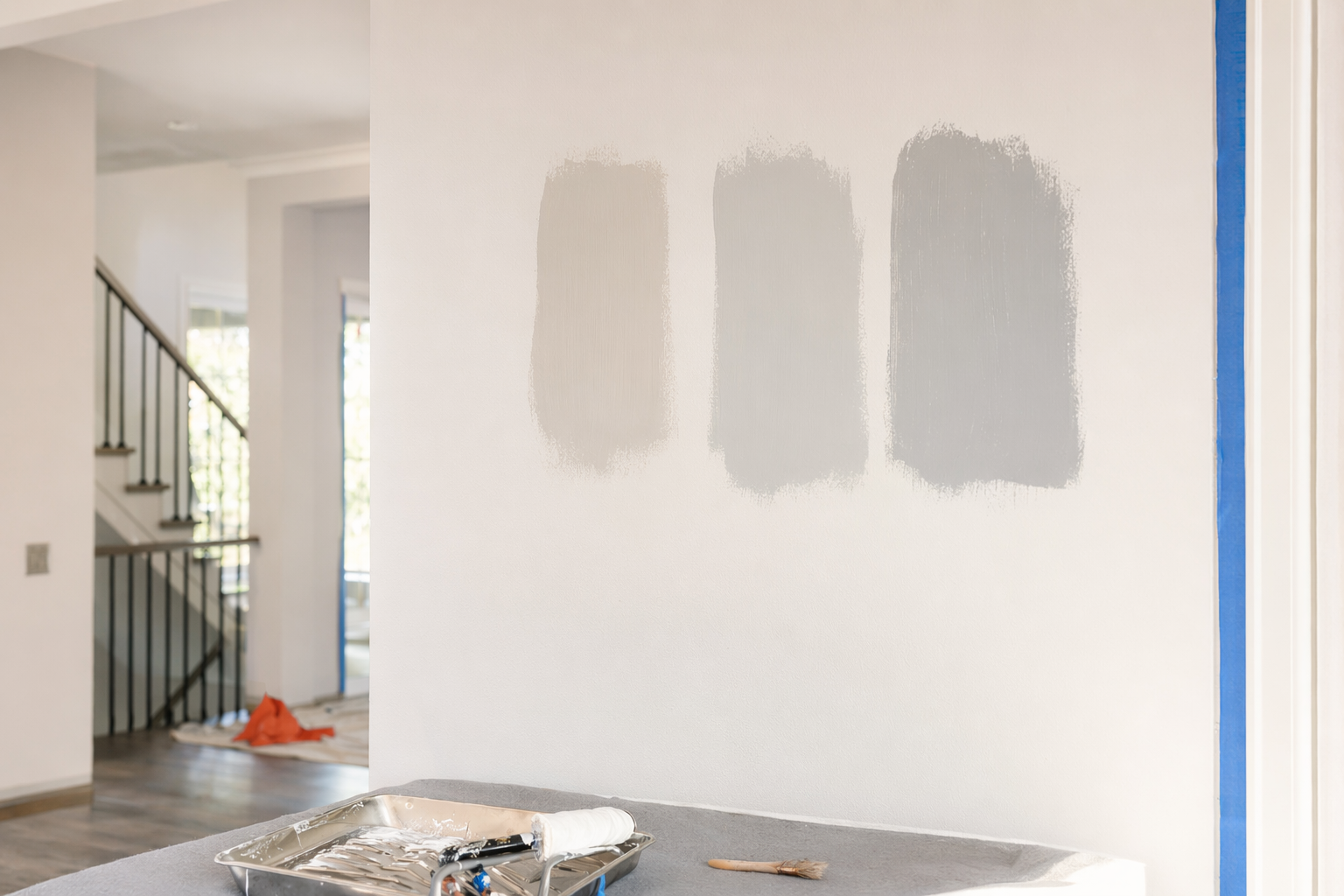
Why paint colors change once they hit your wall
Paint color is never just the color on the label. It changes with sunlight, lamp light, shadows, nearby floors, countertops, rugs, brick, roofing, and even the trees outside your window.
Undertones are the reason many “safe” colors surprise people. A gray may lean blue, green, or purple. A white may feel creamy yellow, pink, or cool blue. Beige and greige can shift warm or muddy depending on the room.
Light matters too. East-facing rooms often look brighter and cooler in the morning. West-facing rooms can look warmer later in the day. North-facing light can make colors feel cooler and flatter, while south-facing light often makes colors look warmer and brighter.
That is why testing matters. It is the easiest way to see whether a color still feels right in your real home, on your real surface, at the times of day you actually use the space.
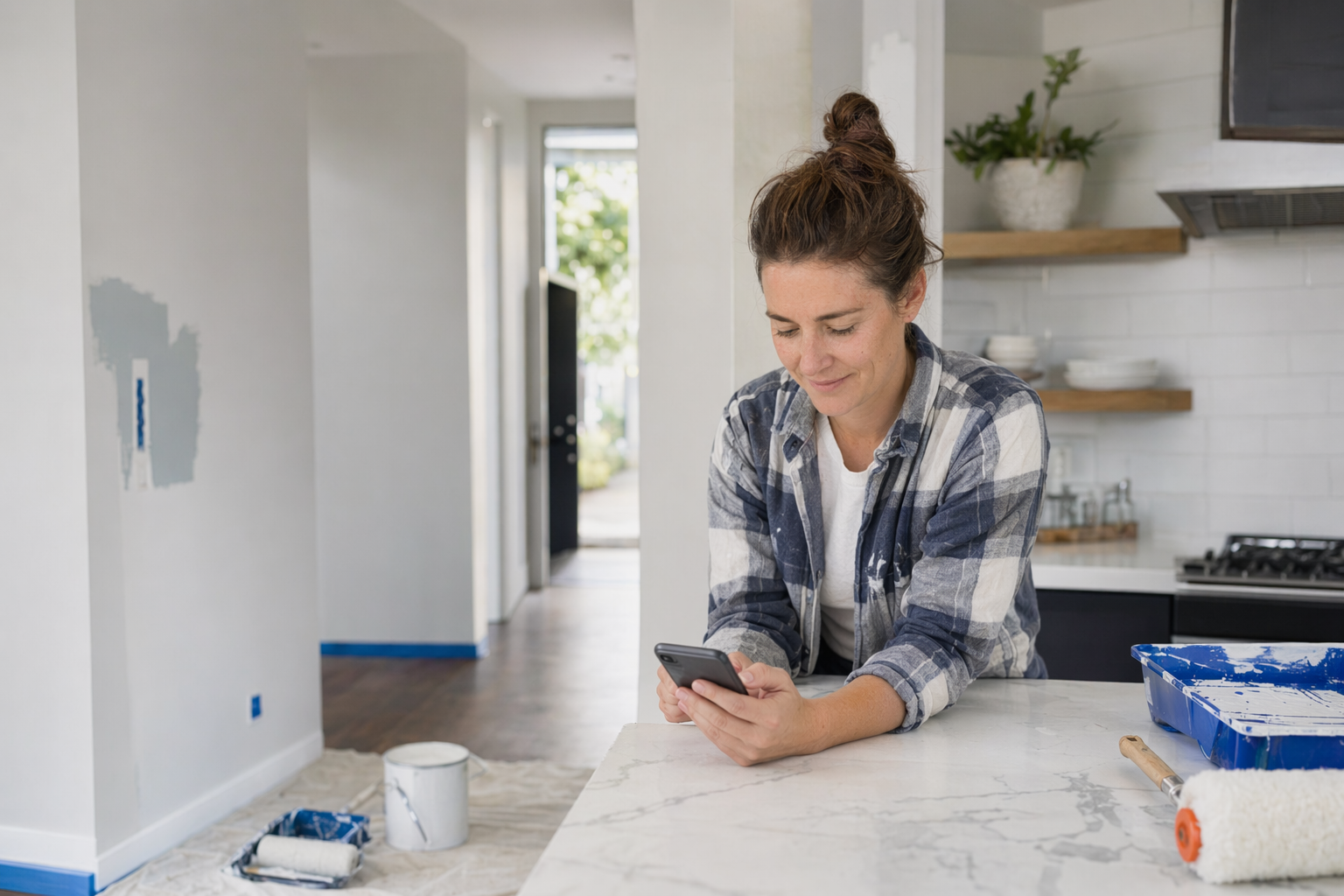
The best way to test a paint color
The goal is simple: test a big enough sample, in the right place, for long enough to see the truth. Tiny chips are helpful for narrowing choices, but they are usually too small to make a final decision.
Use this order if you can:
- Start with 3 to 5 colors you already like from colors.
- Buy sample pots or order peel-and-stick samples.
- Test each color in at least two spots on the wall, or on movable poster boards if you do not want to paint directly on the wall.
- Make the sample large — about 2 feet by 2 feet is much better than a small square.
- Look at it in the morning, afternoon, evening, and at night with lamps on.
- Compare it next to trim, flooring, cabinets, countertops, tile, brick, or siding.
- Live with it for a day or two before deciding.
If you paint samples on the wall, use two coats so you see the color more accurately. If you use poster boards, move them around the room and hold them near corners, windows, and darker walls. A movable sample often gives a clearer answer because the wall under it will not affect the result as much.
For exterior colors, test on more than one side of the house. Sun, shade, trees, roof color, and nearby homes can all change how the paint looks from the street.
What to look for when you test
Do not ask only, “Do I like this color?” Ask, “What is this color doing in my space?” A color can be attractive and still be wrong for your room.
Look for these common issues:
- The color looks too bright once it covers a large area.
- The undertone becomes stronger than expected.
- The color looks dull in low light.
- The shade fights with your floor, tile, cabinets, brick, or furniture.
- The color feels too cold, too pink, too yellow, or too dark at night.
Also step back. Stand in the doorway, sit on the sofa, lie on the bed, and look from across the room. For exterior paint, walk to the sidewalk or driveway. Many colors look very different from a distance.
If you are choosing between two close colors, the one you prefer after 24 to 48 hours is usually the better choice. If both still feel uncertain, go one step lighter or choose the more neutral option. That simple move saves a lot of regret.
Sample pots vs. peel-and-stick samples
Both methods can work. The best one depends on the surface and how exact you want to be.
Peel-and-stick samples are easy, clean, and useful when you want to move the color around the room. They are great for testing wall colors, especially if you are comparing several options at once. But they may not show the finish exactly the same way as real paint.
Sample pots give you the truest look at coverage, texture, and finish because you are using actual paint. They are often better if you are deciding on cabinets, trim, doors, or exterior surfaces where finish really matters. The downside is more time and more mess.
If the project is large or expensive, many homeowners use both: peel-and-stick to narrow the list, then real paint samples for the final two choices. That extra step is usually worth it.
Which finish works best for each surface
Color gets most of the attention, but finish matters just as much. Finish changes how paint reflects light, how easy it is to clean, and how much wall texture or patching shows.
Here is a practical guide for many homes:
- Flat or matte: Good for ceilings and low-traffic adult bedrooms. Hides surface flaws best, but can be harder to wipe clean.
- Eggshell: A common choice for living rooms, dining rooms, and many walls. Slightly soft sheen, easier to clean than flat.
- Satin: Popular for busier walls, hallways, kids' rooms, bathrooms, and some exterior siding. More washable, but shows more wall imperfections.
- Semi-gloss: Common for trim, doors, cabinets, and bathrooms. Durable and easier to clean, but reflects more light and shows flaws.
- Gloss or high-gloss: Usually used more selectively on doors, furniture, or accents. Very shiny, very noticeable, and surface prep must be excellent.
For kitchens, bathrooms, cabinets, trim, and exterior surfaces, prep and product choice matter a lot. The wrong finish can highlight every dent or brush mark. A licensed, insured painter can help you match the finish to the surface condition and the amount of wear it gets.
If your home was built before 1978 and you are sanding, scraping, or disturbing old paint, ask how the painter follows lead-safe work practices. That is an important safety question before interior or exterior prep begins.
How to avoid expensive color mistakes
The biggest mistake is deciding too fast. The second biggest is testing in the wrong way. A little patience can save a full repaint.
Use this checklist before you commit:
- Test large samples, not tiny chips only.
- View them in daylight and at night.
- Check them next to fixed items you are not changing.
- Test the finish, not just the color, for trim, cabinets, doors, or exterior work.
- For exterior projects, view from the street and in shade and sun.
- Confirm the final color name, finish, brand line, number of coats, and surfaces in writing before work starts.
If you hire a painter, compare a few quotes and verify license and insurance. Watch for vague pricing, large cash deposits up front, door-to-door “today only” deals, no proof of insurance, or pressure to sign on the spot. A good pro should clearly describe the prep, paint, finish, and scope.
HuePort is a free matching service, not a painting company or contractor. We help homeowners connect with licensed, insured painters near them for interior and exterior projects. The service is free for homeowners, and you stay in control of the color, the price, and who you hire. If you want help finding local painters, you can get matched.
As a very general guide, sample materials may cost anywhere from about $5 to $20 per color for simple samples, and more if you test multiple finishes or exterior products. Full painting costs vary widely by surface condition, prep, number of coats, paint grade, access or height, and your area, so any range you see online is not a quote.
Test paint colors in large samples, in real light, on the right surface, before you commit to the whole project.
Common questions
How big should a paint sample be on the wall?
Bigger is better. About 2 feet by 2 feet gives you a much more honest read than a small patch, especially for whites, grays, and other subtle colors.
Should I test paint directly on the wall or on a board?
Either can work. Boards are nice because you can move them around the room, while direct wall samples can show the finish more realistically.
Why does my gray paint look blue or purple?
That is usually the undertone showing up under your room's light. Floors, nearby furniture, and window direction can make those undertones stronger.
What finish is best for living room walls?
Eggshell is a common middle-ground choice for many living rooms. It has a soft look and is usually easier to clean than flat paint.
Do I really need to look at paint samples at night too?
Yes. Many people use their rooms most in the evening, and lamp light can make a color look warmer, darker, or more yellow than it does in daytime.
Can HuePort help me hire someone to paint after I choose a color?
Yes. HuePort is a free matching service that can connect you with licensed, insured painters near you, but we do not perform painting work ourselves.